
A Theory for Productivity
I get distracted easily. And it is not just me. A study by the Karolinska Institute* followed more than 8,000 children from age 10 to 14. They found that children spending a significant amount of time on social media platforms such as Instagram, Snapchat, TikTok, Facebook and X develop attention problems and their ability to concentrate is affected. The same was not true for watching TV or playing video games which, ironically, were the proclaimed enemies of society until recently.
I am not a child, but my experience has been oddly similar. In fact, it has been getting much worse recently, to the point where watching an entire movie or playing a video game for a few hours becomes an insurmountable challenge. I can conveniently blame it on my genetics and continue endlessly scrolling my social media apps, yet it hasn’t always been like that. I graduated with a PhD** from Oxford University which required tremendous amounts of focus and hard work for years on end. In the non-fiction bestseller “Deep Work”, Cal Newport argues that concentration is not something we are born with but something that requires deliberate practice. A proverbial muscle of sorts. I tend to agree with him. During my graduate studies, I was part of the System Security Lab, so I am primed to think in terms of frameworks, structures and methods. Therefore the conclusion I arrived at from my life experience as well as months of deeper thoughts on the problem is, well, that my systems are broken.
An excellent foray into the world of habit building using systematic thinking is the book “Atomic Habits” by James Clear. While I highly recommend giving that a read, my goal here is to expand on something more general and yet much simpler and practical in a way. A day-to-day system that acts as a philosophy for living, rather than one purely for productivity. A sort of “Theory of Everything”, an Aristotelian eudaimonia, a golden mean but for your work-life balance.
I don’t want to dwell too long on the dramatic shrinkage of our collective attention spans. Whether the blame is on TikTok, AI chatbots or Netflix is something much smarter people have explored and, as you will see, irrelevant to what I am proposing here. The fundamental problem, in my opinion, is that “we simultaneously feel overworked and underutilized” to quote Greg McKeown in “Essentialism: The Disciplined Pursuit of Less”. We spend enormous amounts of time “at work” but nothing seems to get done. This leads to stress beyond the working day and spoils the little time we have left for enjoyment.
The Grounded Loop is a simple theory, really. The whole idea behind it is that we want to establish a balance of work and rest in our lives. Work is defined as anything that generally requires some effort or friction (your job, studying for an exam, learning a language, cleaning) and rest being more passive or enjoyable (watching a movie, going out with friends, playing video games). It is worth noting that some work can be fun and some rest can be unsatisfactory and the definition for each of us might differ. For instance, I can unwind after a long day by cooking up a nice meal while some people would prefer digging in a coal mine over touching a frying pan.
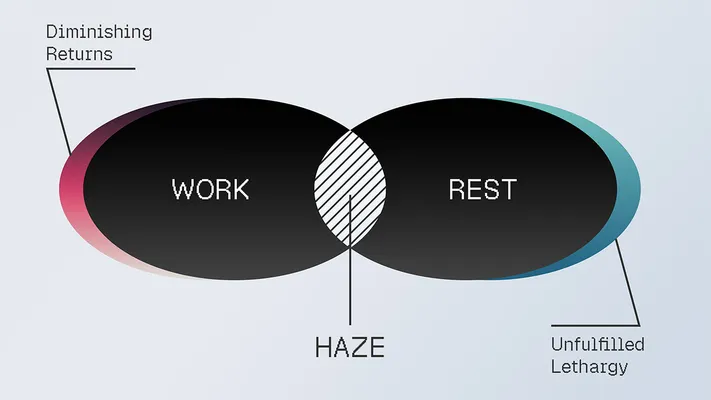
The point is that the two factors in question need to be actively balanced and stay in harmony. Working long hours leads to diminishing returns and burnout. Resting too much leaves us feeling unfulfilled and careless. And then, there is a third factor which I call the “haze” for a lack of a better name. Haze is the time where you are not quite working and not quite resting. A proverbial purgatory of productivity. Have you ever felt that you have worked so hard the whole day only to look back and realize you haven’t achieved anything? That’s haze. In one sentence, the productivity system aims to minimize haze and balance work with rest. Focus with full concentration when you are working and experience full enjoyment while you are resting. Simple enough? Now let’s get to how I propose we achieve this.
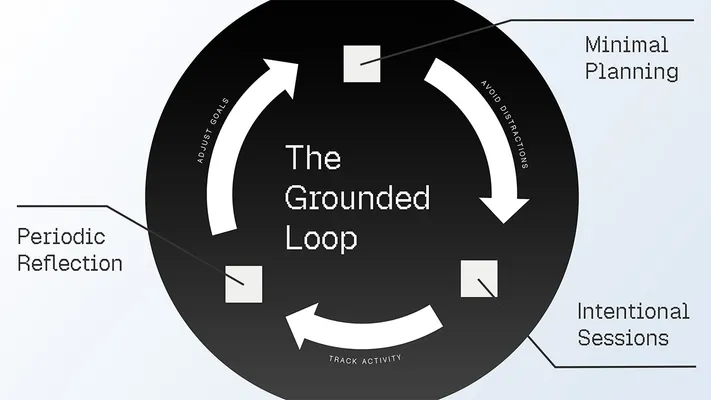
The Grounded Loop consists of three parts, each simple in its own right but particular in the implementation details:
Minimal planning. This step is reserved for selecting the projects you intend on working on and decide on the amount you want to spend on focused work each day. Some ideas for “projects” include your job, personal development, side hustle, reading, etc. It is worth stressing that this step is not the time to create elaborate plans, todo lists or derive short term goals. If we become too specific or prescriptive at this stage, we will waste too much time before we have even started doing our work. Lightweight, clean, minimal planning is the objective. The amount of time we set as our daily goal is also quite important. Once we hit that target, we can rest peacefully for the remainder of the day. It is likely that we are going to be wrong about this number initially. Spoiler alert: we will adjust the numbers later in the loop.
Intentional focus sessions. The key here is when we commit to a focus session to truly commit to it. A focus session can take the form of a Pomodoro-style timer counting down from a predefined time (e.g., 30 minutes) or an open-ended flow timer counting up. Depending on the situation, either one can be useful, but keep in mind that taking breaks is essential and it yields better results over long periods of time. The grander the way you begin your session, the better. In my opinion, the best way to do it is with a physical device, but a digital trigger works as well. Ideally, the focus session also blocks possible distractions including apps, websites and even people (by a physical device signaling to your surroundings that you are busy). Sometimes your job doesn’t allow you to be as dynamic with your focus sessions. The goal is not perfection but best-effort.
Reflection. This is a deliberately chosen time dedicated to looking back at what you have achieved, what has worked so far and what needs adjusting. You could do it once a week, once a month or at whichever interval works best for you. It is likely that you do it more frequently when you start practicing the Grounded Loop or when your routine fundamentally changes. Tracking your focus sessions throughout the reflection period will come in handy, as we often have a hard time recalling objective statistics about our performance. The aim of the reflection step is to understand our work patterns but also to adjust our goals such that they are both aspirational and within reach.
To summarise the whole theory: we plan a little, work intentionally and periodically look back at how we are doing. Again, it is a simple strategy but done right, it works wonders. In any case, a few clarifications on the method are worth mentioning:
Setting the daily goal is a tricky matter. I would bet most people will massively overestimate how much focused work they can do each day. In the now-famous research study done by Anders Ericsson***, the authors found that elite violinists can only sustain at most 4 hours of full-concentration deliberate practice. Our work might not be as taxing as playing the violin but it is unrealistic to expect us to do 8 or 10 hours of focused work a day.
The loop encourages you to minimize scheduling and planning but this is not to say you shouldn’t manage and prioritize your specific tasks. That is a job to perform during a focus session and can take any form that you would like - todo lists, kanban boards, prioritisation frameworks etc. Once you have committed to a focus session, you will find a way to organize your work to best suit your particular needs.
This theory is designed with the knowledge worker in mind. The constraints, as well as the advantages, of physical labor are too different for it to applied directly. Client-facing knowledge workers might have limited use for it as well.
I have been practicing many of the elements of the system for years. That includes the use of Pomodoro timers, site blockers and weekly reflections. However, I never combined them into one unified practice until only around 6 months ago. Since then, I have also been building a tool to help me practice what I am preaching in the easiest way possible. The tool is called Grounded Momentum. It’s not a flawless technology but it has been extremely helpful to me and it is better every day (or at least every week). I have been more concentrated, more productive and most importantly I am finally able to enjoy my free time without feeling guilt about my productivity during the day. That is the whole point of the loop, the tool just helps applying the theory much easier. You can try the app at https://groundedmomentum.com.
* “Digital media, Genetics and Risk for ADHD Symptoms in Children - a Longitudinal Study”, Samson Nivins, Michael A. Mooney, Joel Nigg, Torkel Klingberg, Pediatrics Open Science
** I graduated with a DPhil, but let’s not get pedantic
*** “The Role of Deliberate Practice in the Acquisition of Expert Performance”, K. Anders Ericsson, Ralf Th. Krampe, Clemens Tesch-Römer, Psychological Review

 Join the Discussion